Automate the Boring 20 Minutes: Invoices, Reminders, Follow-Ups

Ask a room of small business owners how they chase late invoices and you will hear the same shrug in different words. On r/smallbusiness one owner put it plainly: about a fifth of his clients had started treating due dates like a suggestion. Another summed up the whole routine in four words: send invoice and pray.
The numbers behind the shrug are worse than the shrug. Intuit QuickBooks surveyed 2,487 US small businesses in January 2025 and found 47 percent had invoices overdue by 30 days or more. The businesses carrying overdue invoices were owed more than $17,000 on average. That is payroll, materials, the next job's deposit, sitting in somebody else's account. Xero's data tells the same story from the other side: US small businesses are paid 7.8 days late on average, the shortest gap in four years, and still late. QuickBooks' 2025 Late Payments Report has the full breakdown.
The chase is a sequence, not a mood
Most owners chase invoices the way they remember to: when the bank balance looks thin, or when an invoice has been sitting long enough to feel embarrassing. That is the whole problem. A reminder sent when you happen to think of it arrives whenever, sounds however you felt that day, and sometimes never arrives at all.
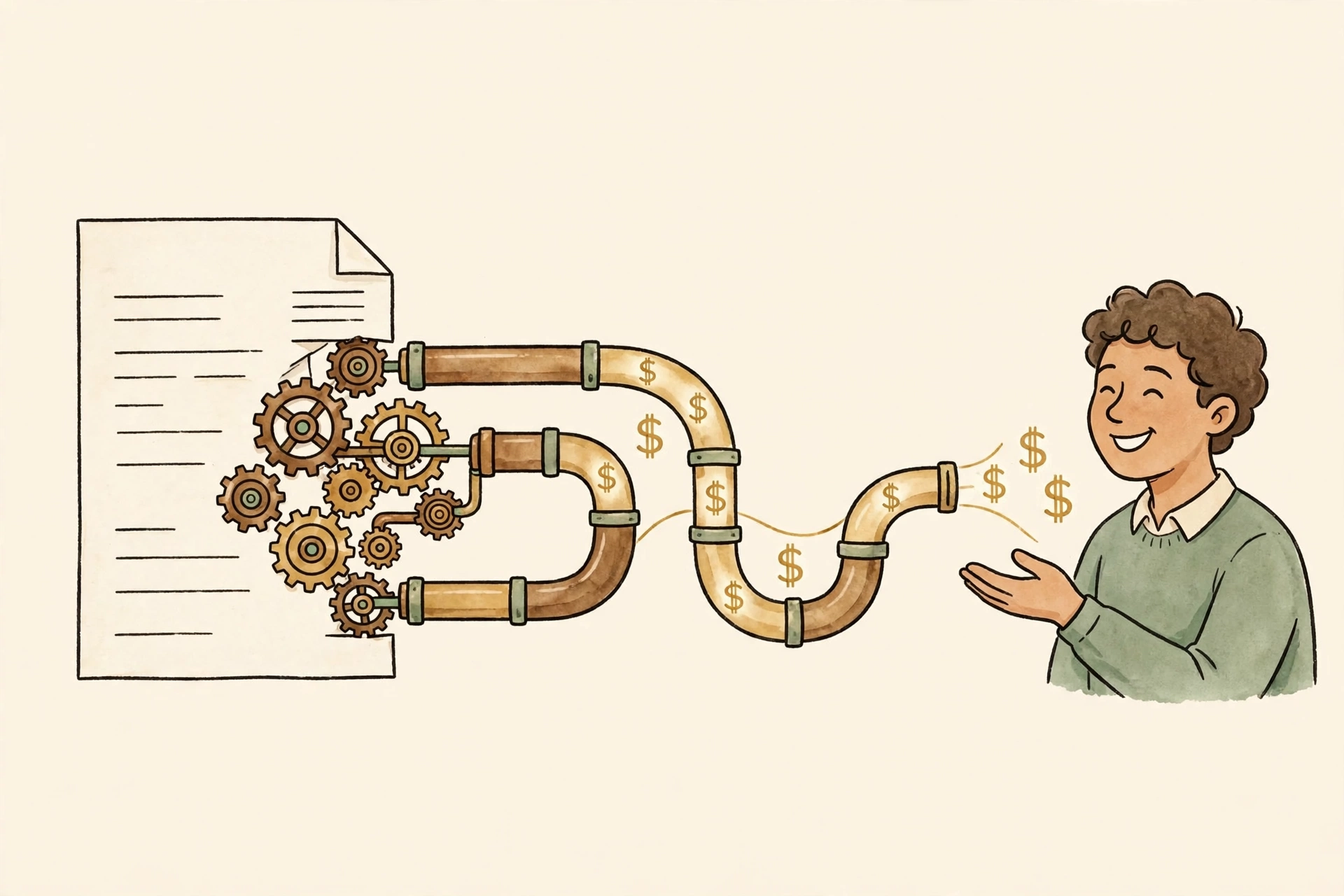
The fix is a ladder with fixed rungs, written down once, and then it runs itself. The invoice goes out the day the work is done, not Friday, not when the paperwork pile gets tall. A short note goes out three days before the due date: amount, due date, the link to pay. On the due date, the system sends the invoice again with the payment link at the top. Three days after the due date, a second nudge, still polite, still short. Seven days after, the tone changes. That one names the amount, the date, and asks for a payment date in reply.
None of that needs you. QuickBooks and Xero both send scheduled reminders out of the box, and the setup takes about twenty minutes: pick the rungs, write each message once, turn it on. Businesses using automated reminders in Xero save about three hours a week, and Xero customers who take online payments get paid up to twice as fast. The three hours is the point. That is the kitchen-table hour, back.
Where the robot stops
Automation stops where a human has to start. The client who disputes the invoice, the one who promised twice and paid never, the one who answers the third email with a problem instead of a payment, all get a phone call, from you, the same week. A sequence that keeps emailing a disputed invoice argues with a customer on your behalf, and it will lose.
The terms do half the work
The reminder ladder only works if the invoice itself is clear. Net 30 on an invoice to a homeowner who expected to pay at the door is a misunderstanding you scheduled for yourself. My own terms are 14 days on Stripe invoices, with a late fee that kicks in after 30, applied flexibly. The late fee earns its keep before anyone is late: it tells the client, in writing, that late has a price, and the client reads it before the work starts.
Put a pay-now button on the invoice and take cards and ACH, not just checks. Every extra step between "I should pay this" and "paid" is a place for the intention to die. Most late payers saw the email, meant to pay that night, and then did not.
The wiring, if you want it done properly
Built-in reminders cover most shops. If your invoicing tool does not send reminders, or you want the nudge to arrive by text, the wiring is a small job. An automation tool like Zapier or Make watches the invoice status in QuickBooks or Xero and sends the message when a due date passes with no payment. The sequence stops itself the moment payment lands, which is the part people forget to build and then regret. A reminder that fires after the client already paid costs you more goodwill than the late payment cost you cash.
This is the part of the job I actually enjoy building. The ladder is five messages and one rule: stop on payment, escalate on silence.
Start with the invoice you sent longest ago. Write the seven-days-late message for that one first, send it by hand, and then build the ladder so you never write it again.
Sources
- Intuit QuickBooks, 2025 US Small Business Late Payments Report (47% with invoices 30+ days overdue; more than $17,000 owed on average)
- Xero, Small businesses getting paid quicker, but still late (US businesses paid 7.8 days late on average; automated reminders save 3 hours weekly; online payments up to twice as fast)