My Wife Asked for a Store She Owned. I Didn't Have a Good Answer.
My wife has sold printable PDFs on Etsy for two and a half years. 382 sales, 4.8 stars across 47 reviews. Not a hobby — a small business that works, run by someone who knows exactly what that platform charges her and why.
She came to me and asked for something reasonable: a website that did what the platforms do, without everything bolted on top of it. She wanted to own the thing.
I've been building for the web for 26 years. Five hundred sites or so. Seventeen of those years I ran web infrastructure for a 21,000-student university. And when my own wife asked me that question, the honest answer was embarrassing: your options are pay rent forever, or be a page on someone else's website.
What "free" actually costs a real shop
Etsy listings cost 20¢ each. That's not once — listings expire after four months and renew automatically, so a shop with 150 items pays about $90 a year before it sells anything at all. Then 6.5% comes off every sale, plus payment processing on top of that.
Payment processing is unavoidable. Every store everywhere pays it. The platform's cut on top of it is a choice someone made, and it's charged forever, whether or not the platform did anything for you that month.
The other options weren't better. Most builders hand you a free plan, then charge for the parts that turn it into a business — your own web address, and your own name in the footer instead of theirs. You buy the bear, and then you buy every outfit separately. Reviews, email marketing, discount codes, SEO tools: all standard, all extra.
So I built the thing I couldn't point her to
It started small — a store generator and not much else. It kept growing, because a real shop turns out to need a lot: variants, shipping rates, coupons, digital downloads with expiring links, an email list, reviews, discount codes. Her store has been the test case the whole way, which means the features got built against someone who actually sells things rather than against my idea of someone who sells things.
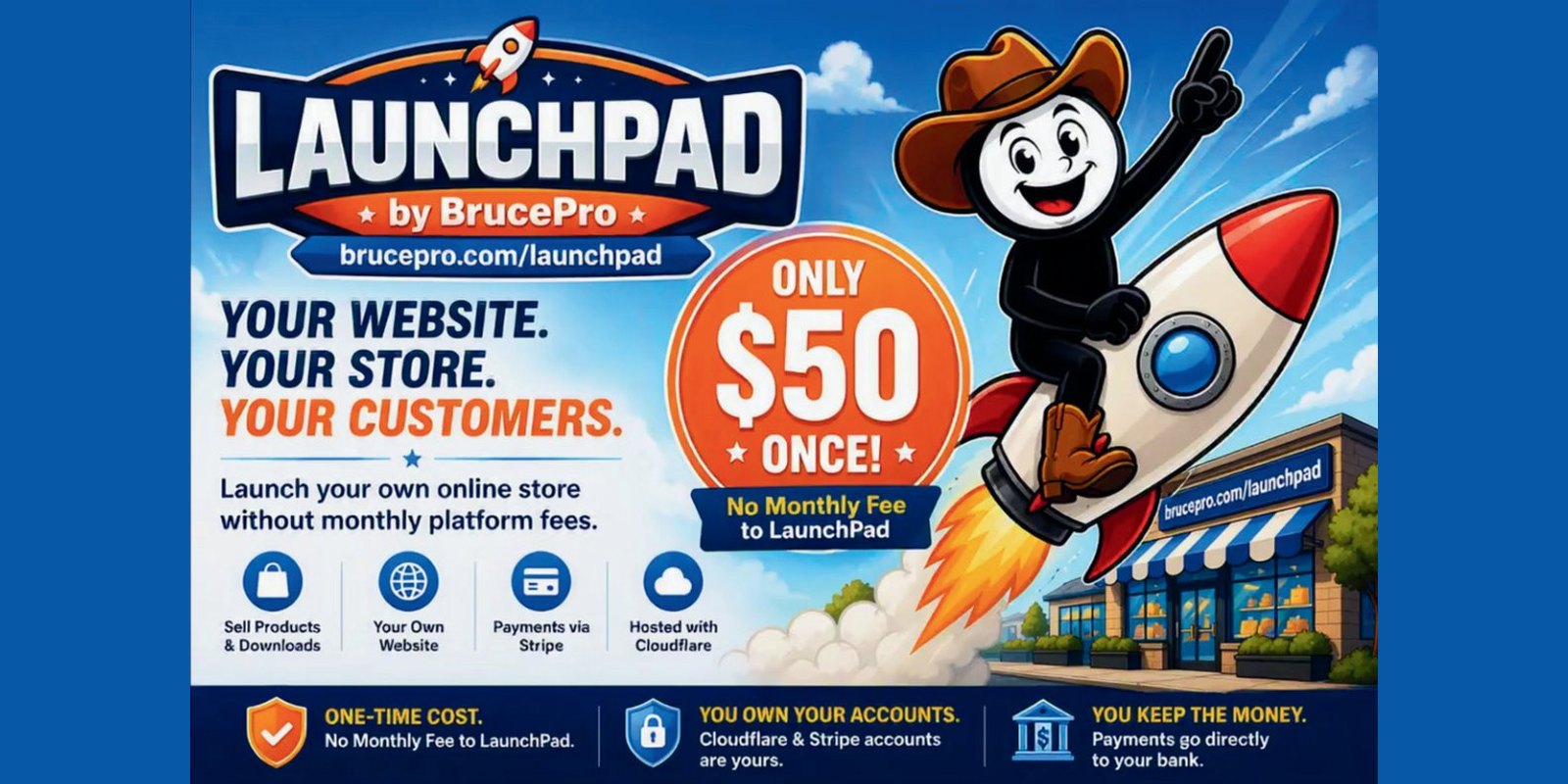
What it turned into is a full website and store management app that runs on your Windows machine and publishes to your own Cloudflare account. 26 years of doing this for other people, distilled into something a person can run themselves.
Why it costs $50, and why it costs it once
I didn't make it free. I put real time into it and I value that time. Free software from a one-person shop is also a promise I'd eventually have to break.
But I didn't want to be sly about it either. The obvious business move is a subscription — recurring revenue, a number that goes up, customers who can't leave without losing their store. I knew what I was building. It was supposed to be about ownership, not rent. Charging rent for it would have made the whole thing a lie.
So: $50, once. No subscription. No cut of your sales — payments go from your customer to your Stripe account to your bank, and I'm not anywhere in that path. The Cloudflare account is yours. The Stripe account is yours. The site files are on your computer. If I disappeared tomorrow your store would keep running, because nothing about it depends on me still being here.
What it isn't good at
Getting you customers. That's the honest weak spot, and it's the biggest one.
A marketplace like Etsy puts your work in front of people who are already shopping, and charges you for the privilege. LaunchPad gives you a store and leaves the finding of customers to you. It ships the tools for that job — a product feed for Google Shopping, Pinterest, TikTok and Meta, a sitemap, structured data, an email list, discount codes — but tools are not an audience, and I'm not going to pretend otherwise.
That's the part I'm working on next: taking what I know about getting a small business found online and putting more of it inside the app, where it's useful, instead of leaving it as something you have to already know. I'm not going to promise you a date or a feature name for something I haven't built yet.
Version 0.1
That's the real version number. It works, it's being used, and it will get better. What it doesn't have, I say plainly: no recurring-subscription products, no bulk price editing yet. I'd rather you know that before you spend $50 than find out after.
The plan is to compete on two things — what it can do, and being straight with you about what it can't. The second one is rarer than it should be in this category, and it's the part I can guarantee regardless of how the first one goes.
Find out more
The full breakdown — real fee comparisons against Etsy, Shopify and Square, what LaunchPad is not, and what happens to your store if I disappear — is all on the product page. $50 once, Windows, instant download, 14-day refund.